Published
6 minute read
Online education has made aesthetic medicine easier to enter than ever. Licensed healthcare professionals can study facial anatomy, treatment protocols, product characteristics, and complication management from home, often on their own schedules. That flexibility gives providers a valuable introduction to the field, but aesthetic procedures require physical skills that develop through supervised clinical practice.
A certificate confirms that you completed a training course. Your ability to assess a patient, handle an injection confidently, and adjust your technique when necessary depends heavily on what you’ve practiced in person. For medical professionals preparing to treat real patients, hands-on training is the point where theoretical knowledge begins to function as confident clinical judgment.
Videos and virtual lessons are useful for studying the basics and becoming familiar with the facts. You can replay an anatomy lecture, review the pharmacology of botulinum toxin, compare dermal filler products, and revisit safety protocols until the material feels familiar. Those are good things to know, and a strong online component can make your time in the clinical setting much more productive.
The limitation appears when an online aesthetic certification is treated as complete preparation for patient care. Watching an experienced provider administer an injection can’t recreate the tactile experience of holding a syringe, stabilizing the skin, controlling depth, or feeling how tissue responds as a product is placed. A camera also provides a fixed view, while an injector needs to evaluate the patient from several angles and account for facial movement, asymmetry, proportions, and treatment history.
Online courses also leave little room for immediate correction. A provider can unknowingly develop poor habits in positioning, hand placement, injection angle, or pacing since they aren't practicing in real time. Once those habits become familiar, they can be difficult to change. Supervised hands-on training allows an instructor to identify them early and explain exactly how to improve.
Being educated on human anatomy is essential in medical aesthetics, especially for injectable treatments. Providers need a clear and complete understanding of facial muscles, vascular pathways, tissue planes, fat compartments, and bony support before ever going towards a patient with a needle or other medical tool.
Diagrams create a clean, standardized view of these structures, but real patients are far less uniform. Facial anatomy varies from one person to the next, and previous procedures, aging, scars, skin thickness, and natural asymmetry can change how a treatment should be approached.
In-person training teaches students to connect the anatomy they studied with the face they are evaluating. An instructor can help you palpate important landmarks, observe muscle movement, select an appropriate treatment area, and recognize when a standard approach needs to be modified. During dermal filler training, you also begin to understand tissue resistance and how product placement affects facial contours in real time.
This process turns memorized information into working knowledge and strengthens your ability to assess each patient individually rather than relying on an injection map.
New injectors frequently understand a procedure on paper before they feel prepared to perform it. That gap is normal—confidence develops as you move through the full treatment process with a patient, from consultation and assessment to product preparation, injection, and aftercare.
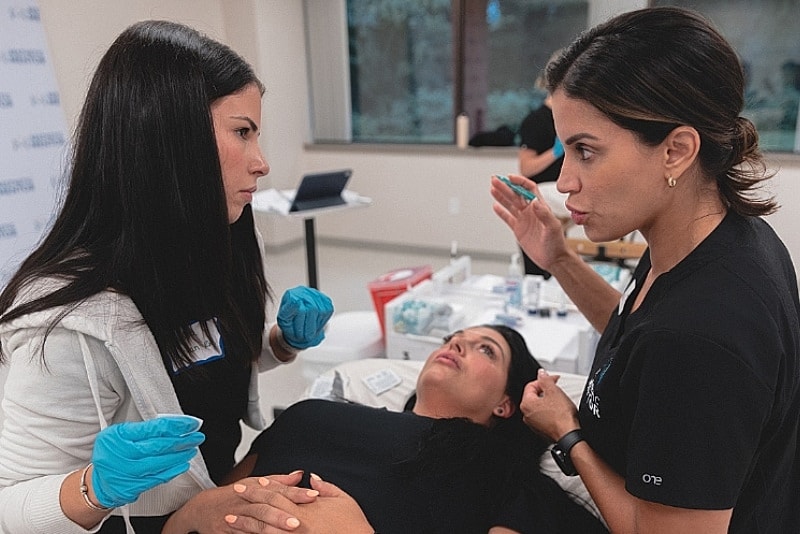
Hands-on experience gives students room to slow down and think through each decision with an instructor nearby. You can ask about dosage, placement, positioning, or technique at the moment the question arises. If your hand angle needs adjustment or your assessment overlooks an important detail, you receive immediate feedback while the lesson is still unfolding.
That close supervision also helps students become more comfortable communicating with patients. Aesthetic providers need to explain realistic outcomes, discuss risks, obtain informed consent, and guide someone through a treatment calmly. These skills are difficult to develop through videos alone because they depend on a live exchange with another person.
With each supervised treatment, the equipment feels more familiar and the sequence becomes more natural. Students can begin concentrating on the finer points of their technique instead of devoting all their attention to simply completing the procedure.
Knowing that a complication can occur is different from recognizing its earliest signs during treatment. Effective medical aesthetics training should prepare providers to prevent problems, identify concerning changes, and take appropriate action when something does not progress as expected.
In-person instructors can demonstrate safe product preparation, sterile technique, patient positioning, injection depth, and methods for reducing avoidable risk. They can also walk students through the clinical reasoning behind each decision. That discussion helps new providers understand why a technique is appropriate instead of copying a series of motions.
Hands-on training also creates space for judgment. An educator may decide that a treatment plan should be adjusted, postponed, or declined based on the patient’s anatomy or medical history. Seeing that decision made in practice helps students understand that good aesthetic care includes knowing when to proceed carefully and when to step back.
A certification can help establish that you’ve completed formal education, but employers also want to know how well that education prepared you to work with patients. Medical spas, dermatology offices, plastic surgery practices, and established injectors may ask how much supervised clinical experience you received, which treatments you performed, and how your instructors evaluated your progress.
Employers may also want to hear how you conduct a consultation, build a treatment plan, document care, protect patient safety, and respond when a patient’s expectations are unrealistic. For an injector early in their career, being able to discuss actual clinical experiences can make a stronger impression than describing lessons completed entirely online.
Continuing medical education and additional training remain important as your career develops. Practice clinics, advanced courses, and mentorship give providers opportunities to refine their techniques and expand their capabilities responsibly. A successful career in aesthetics grows through repeated patient contact and thoughtful feedback over time.
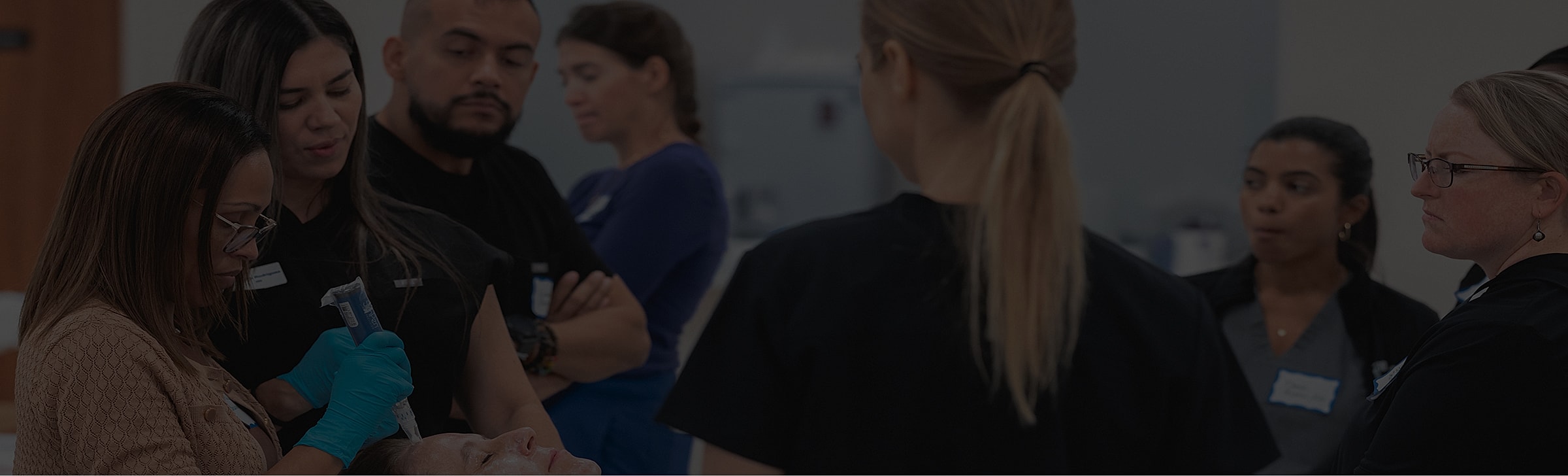
At Aesthetic Mentor, we combine virtual coursework with extensive in-person clinical training in both Boston and Hartford. Students arrive with the academic foundation needed to make the most of their time in the treatment room, then work with live models under the guidance of board-certified plastic surgeon Dr. Joseph A. Russo and his team of experienced educators.
Class sizes are intentionally limited. The student-to-educator ratio is never higher than 2:1, and some courses provide 1:1 instruction. This model gives each student meaningful access to instructors, more opportunities to perform treatments, and feedback tailored to their individual technique.
The training extends across foundational and advanced areas of aesthetic medicine, including neurotoxin training, dermal filler training, and continued practice clinics. Students can build their skills in a structured sequence while receiving guidance about the next appropriate step in their education.
Online education can prepare your mind for aesthetic practice. Hands-on experience prepares your hands, your clinical judgment, and your ability to care for the person in front of you. At Aesthetic Mentor, that direct patient experience is central to the training because safe, confident providers are built through practice.